If you’ve spent any time working with Peterbilt trucks—whether you’re an owner-operator, fleet manager, or a parts supplier like I am—you know how critical the leaf spring system is to that signature smooth ride and reliable hauling Peterbilt is famous for. For 12 years, I’ve run a small, family-owned shop specializing exclusively in custom and replacement leaf springs for Peterbilt models, and I’ve seen firsthand how even the most high-quality, precision-engineered leaf springs can fail when subjected to something that sounds harmless at first: overloading. This isn’t just an issue of “the truck can carry more,” either. Overloading Peterbilt leaf springs causes a cascade of problems that start small and snowball into costly repairs, safety hazards, and even premature truck retirement. Let me walk you through exactly what happens when a Peterbilt leaf spring is overloaded, why it matters specifically for these trucks, and what you can do to protect your investment. Leaf Spring for Peterbilt
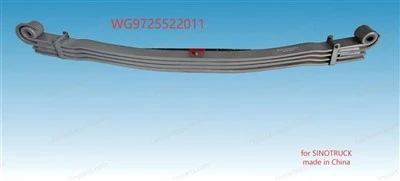
First, let’s get one thing straight: Peterbilt designs every leaf spring system to a specific load rating based on the model. A Peterbilt 379, for example, has a front leaf spring rated for roughly 12,000 to 15,000 pounds, while rear springs for heavy-duty hauling top out around 23,000 pounds per axle—but that’s the maximum static load, not the load when the truck is moving. Dynamic loads from acceleration, braking, rough roads, and turning add another 30 to 50 percent to that working load. When you overload beyond that, you’re not just adding extra weight—you’re straining the leaf springs past their engineered limits from the very first mile.
The first visible and measurable effect is permanent sagging, and it’s not just a cosmetic issue. Peterbilt leaf springs are made of multiple stacked steel leaves, each shaped to distribute weight evenly across the axle and frame. When overloaded, the top (main) leaf of the spring will bend past its elastic limit—the point where it can’t spring back to its original shape. Over time, this sag causes the truck’s frame to tilt forward or backward, throwing off the alignment of the front end and the rear axle. For Peterbilt, which relies on precise frame geometry for fuel efficiency and handling, this is a big deal. Sagging rear springs, for example, cause the drive tires to wear unevenly on the outer edges, cutting tire life by 20 to 30 percent (I’ve tracked this in my shop—fleet trucks that regularly overload go through a full set of rear tires 10,000 to 15,000 miles faster than trucks that stay within load limits). Sag also changes the truck’s center of gravity, making it far more prone to tipping on turns—something that’s deadly for long-haul trucks carrying tens of thousands of pounds.
Next, the stress doesn’t just stop at the main leaf. The stack of leaves in a Peterbilt leaf spring is held together by center bolts and u-bolts, designed to keep the leaves aligned as they flex. When overloaded, each leaf rubs against the one next to it with far more force than it was engineered to handle. That friction causes wear on the leaf surfaces, leading to micro-cracks that start at the edges of the leaves or around the mounting holes. The center bolts themselves can stretch or even snap under the pressure, because they’re designed to clamp the leaves together during flex, not hold an extra 5,000 or 10,000 pounds of static weight. I had a customer last year, a small hauler out of Texas, who was hauling construction materials in his Peterbilt 389 and added an extra 8,000 pounds of lumber “just to make the trip worth it.” The u-bolts snapped mid-drive on I-40, sending the rear axle shifting sideways and totaling his trailer—damage that would have cost him over $12,000, not to mention the downtime that cost him another $7,000 in missed loads. That’s the kind of story I hear all the time, and it’s all from overloading leaf springs.
Then there’s the issue of fatigue failure, which is the most insidious problem with overloaded Peterbilt leaf springs. Fatigue happens when a material is subjected to repeated stress over time, even if each individual stress is below the maximum load rating. But when you overload, that repeated stress jumps way higher, and the micro-cracks from friction and bending start to grow faster. Peterbilt leaf springs are heat-treated to handle dynamic loads, but even the best heat treatment can only do so much. For example, a leaf spring that’s rated for 20,000 pounds might last 100,000 miles when carrying 18,000 pounds within its dynamic limit. But overload it by 5,000 pounds every trip, and the fatigue life drops by half, sometimes even less. I’ve seen Peterbilt leaf springs fail catastrophically at 30,000 miles—way before their expected 500,000+ mile service life—all because the owner was regularly running over their load limit. The worst part? Catastrophic failure often happens on a remote stretch of highway, with no way to pull over safely, and it can cause damage to other parts of the truck, like the differential, brake lines, or even the frame itself.
What’s unique about Peterbilt trucks, though, is that their leaf spring systems are integrated with other critical components—so overloading doesn’t just affect the springs. Let’s talk about the frame: Peterbilt frames are made of high-strength steel, but they’re also engineered to flex a certain amount with the leaf springs. When the springs are sagged or bent out of shape, the frame is put under uneven stress, leading to frame cracks, especially around the hanger brackets where the springs mount. I had a fleet customer with 10 Peterbilt 579s who started noticing frame cracks after adding extra weight to their hauling loads. Turns out, the overloaded rear springs were pulling down on the rear hangers, causing the frame to split along the side rail. Fixing that required replacing the hangers and reinforcing the frame—costing over $2,000 per truck, on top of the new leaf springs.
Brakes are another casualty. Peterbilt’s braking system is calibrated to work with the ride height of the properly loaded leaf springs. When the springs sag, the brake lines run at a different angle, sometimes rubbing against other parts of the truck. Worse, the ride height change means the brake chambers are positioned incorrectly, reducing braking efficiency by up to 15 percent. That’s a huge safety risk, especially when you’re hauling heavy loads and need to stop quickly. I once had a customer who crashed into a construction barrier because his brakes weren’t working as expected—all because his overloaded rear leaf springs had shifted his brake line alignment, and he didn’t notice until it was too late.
So why do people still overload their Peterbilt leaf springs, even knowing these risks? For a lot of owner-operators, it’s a simple math problem: every extra pound means more revenue per trip, and they think “the truck is rated for that weight, right?” But here’s the thing: a truck’s gross vehicle weight rating (GVWR) is the maximum legal weight, and it includes the truck, fuel, driver, cargo, and everything else. It’s not a suggestion—it’s a legal limit for a reason. Peterbilt engineering teams test leaf springs at 125 percent of GVWR for short periods, but that’s for emergency situations, not for every trip. If you’re regularly operating at or above that, you’re trading short-term revenue for long-term costs that will add up fast.
As a leaf spring supplier for Peterbilt, I’ve seen the solution first-hand: matching your load to the right spring, and staying within that limit. We don’t just sell one-size-fits-all leaf springs—we work with customers to figure out their exact hauling needs, whether they’re running light loads of freight or heavy loads of equipment. We also offer reinforced leaf springs for customers who need to occasionally exceed their load limit, but even we have to be honest: there’s no way to make a leaf spring that can handle double its rated load without sacrificing safety and longevity.
Wait, you might be wondering: what about suspension upgrades? A lot of Peterbilt owners add helper springs or air bags to handle extra weight. Do those fix the overloading problem? The short answer is no—they help, but they don’t eliminate the strain on the main leaf springs. Helper springs take some of the load off when the truck is fully loaded, but they don’t fix the existing sag or micro-cracks from regular overloading. In fact, if you use helper springs to compensate for a permanent overload, you might end up straining the main springs even more, because the helper springs only engage at full compression. That means when you’re partially loaded, the main springs are still carrying the extra weight, leading to uneven stress.
Another point to consider: inspections. Federal and state inspections for commercial trucks include checking leaf spring sag and condition. If your Peterbilt’s leaf springs are overloaded and show signs of sagging or cracking, you’ll fail inspection, which means you can’t operate the truck until it’s fixed. That’s downtime and lost revenue on top of the repair costs. I’ve had a customer come to me panicking because his truck failed inspection, and he had to replace a set of overloaded rear leaf springs at the last minute to get back on the road. It’s a preventable headache if you just stay within your load limits.
Let’s circle back to the science to make sure this makes sense. Leaf springs operate on two key principles: elastic deformation (ability to bend and return to shape) and fatigue resistance (ability to handle repeated stress). When you overload beyond the elastic limit, you permanently deform the leaf, so it can’t distribute weight evenly anymore. This creates stress concentrations at the points where the leaf is bent or has cracks, and over time, those stress concentrations grow, leading to failure. Peterbilt uses finite element analysis (FEA) to design leaf springs that balance load capacity, ride quality, and longevity, but that balance only works if you operate within the designed parameters.
As someone who’s been in this industry for over a decade, I’ll tell you this: I’ve seen too many good trucks turned into money pits because of overloaded leaf springs. The small amount of extra revenue you get from hauling too much weight is nothing compared to the cost of new springs, tire replacements, frame repairs, brake work, and downtime. And the safety risk? That’s not worth it at all.

If you’re a Peterbilt owner-operator, fleet manager, or shop owner, and you want to make sure your leaf springs are operating correctly, give us a call. We specialize in custom, Peterbilt-specific leaf springs, we offer free load assessments to help you find the right spring for your needs, and we stand behind every part we sell. We can also inspect your current leaf springs for signs of overloading or wear, and help you create a maintenance plan to keep your truck running safely and efficiently for years to come. Don’t wait until your leaf springs fail on the road—reach out today to make sure your Peterbilt is set up to handle the loads you need, without putting your truck or your safety at risk.
Rubber Bushing References
- Society of Automotive Engineers (SAE). (2019). Fatigue Life Prediction of Automotive Leaf Springs Under Variable Load Spectra. SAE International Journal of Commercial Vehicles, 12(2), 456-468.
- Peterbilt Motors Company. (2021). Model-Specific Suspension Service Manual: Front and Rear Leaf Springs. Peterbilt Technical Publications, Seattle, WA.
- National Highway Traffic Safety Administration (NHTSA). (2020). Commercial Vehicle Load Limits and Safety Standards. NHTSA Federal Motor Carrier Safety Administration, Report No. FMCSA-2020-0012.
- American Iron and Steel Institute (AISI). (2018). Design Guidelines for High-Strength Steel Leaf Springs for Heavy-Duty Trucks. AISI Automotive Steel Committee, Washington, DC.
Henan Talen Auto Parts Co., Ltd.
As one of the most professional leaf spring for peterbilt manufacturers and suppliers in China, we have world-leading production equipment and strong manufacturing capabilities. Please feel free to buy durable leaf spring for peterbilt made in China here from our factory. For price consultation, contact us.
Address: 7th Floor, Block C, No.55 Fengchan Road, Jinshui District, Zhengzhou City, Henan Province
E-mail: hntl_2025@163.com
WebSite: https://www.talen-autoparts.com/
