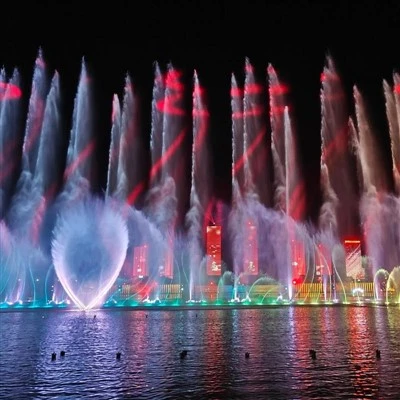
If you’ve ever stood in a plaza, park, or resort at dusk, watching water arcs twist, sway, and sync to a song—maybe a ballad that tugs at your heartstrings or an upbeat pop track that makes you tap your foot—you’ve experienced a musical fountain. I’ve spent over a decade as a musical fountain supplier, traveling to install these systems across continents, and every time I hear a crowd gasp as the first note hits and the water dances in time, I’m reminded that this isn’t just a modern gimmick. It’s an art form rooted in thousands of years of human ingenuity, blending engineering, music, and performance to create something that feels almost magical. Musical Fountain
To talk about the history of musical fountains, we have to start way before electricity, way before digital control systems, and way before speakers could blast audio across an open plaza. The earliest traces of water used for entertainment and music date back to ancient civilizations where harnessing water’s force wasn’t just a luxury—it was a marvel that set powerful rulers apart. In ancient Egypt, around 2000 BCE, artisans built hydraulic fountains that used pressure from rising groundwater to push water into intricate shapes, some tuned to produce soft, resonant sounds when water passed through carved stone or metal channels. These weren’t synced to music as we know it, but they were designed to delight: pharaohs would host banquets with these fountains, their soft gurgle adding to the atmosphere of feasts and religious ceremonies. A few centuries later, in ancient Greece, engineers took this a step further. Hero of Alexandria, the brilliant mathematician and inventor, wrote Pneumatics around 10 CE, a book that laid out designs for machines powered by air and water pressure. One of his most famous creations was a “singing fountain”: a system where water flowed through organ pipes, creating a steady musical note as it moved, all controlled by hidden levers that let priests or entertainers adjust the pitch. This wasn’t syncing water to pre-recorded music, but it was the first time water was used as a musical instrument—foundational to everything that came after.
Fast forward to the Middle Ages in Europe, and fountains became central to monastic gardens and castle courtyards, but the musical element faded a bit. The focus shifted more to grand, symmetrical designs that showed off hydraulic skill, rather than sound. That changed during the Renaissance, a time when creativity and innovation exploded, and rulers competed to build the most impressive estates. By the 16th century, Italian engineers had revived Hero’s hydraulic ideas, adding complex gears and valves to adjust water flow. The Villa d’Este in Tivoli, Italy, built in 1550, is a perfect example. Its gardens are dotted with over 500 fountains, many with hidden mechanical devices: some would spout water suddenly to surprise guests, others played soft chimes when visitors stepped on hidden pressure plates. It was interactive, it was theatrical, and it used water to create both sight and sound—this is widely seen as the predecessor to modern musical fountains. Royal courts across Europe took note, and by the 17th century, France’s Louis XIV had the Gardens of Versailles, where fountains were choreographed to match the rhythm of live orchestras playing during royal events. Now, water was moving in time to real music, performed right there on the estate, all controlled by a team of engineers and musicians coordinating in real time. It was a logistical nightmare, but it worked—though only for small, private audiences, never for large public gatherings.
The real turning point for musical fountains came with two 19th-century innovations: electricity and the Industrial Revolution. Before this, every movement of the water relied on manual cranks, heavy gears, or natural water pressure, which made it impossible to sync precisely with music or to create complex, dynamic patterns. Electricity changed that. The first electric musical fountain was demonstrated at the 1893 World’s Columbian Exposition in Chicago, a fair that drew 27 million visitors and introduced dozens of new technologies to the public. Engineers created a system that used electric pumps to control water height and movement, paired with electric lights to color the water, and for the first time, it could be synced to recorded music. Wait, recorded music was still in its infancy—this fair used gramophones playing 78 RPM records, which were large, fragile, and only had a few minutes of audio. But even so, it was a revelation. Crowds lined up for hours to watch water dance to popular songs of the day, something no one had ever seen before.
For the next 60 years, musical fountains evolved slowly, limited by technology. Pumps were bulky, control systems were mechanical, and syncing water to music meant manually adjusting valves one by one. Then, in the 1960s, two inventions transformed musical fountains from niche attractions to global, large-scale entertainment: digital control systems and low-cost loudspeakers. In 1969, the first modern large-scale musical fountain was installed at the Bellagio Fountains in Las Vegas? No, wait—Bellagio came much later. The 1960s’ breakthrough was the fountain at the Garden of the Gods in Colorado Springs, but more importantly, in 1970, the World’s Fair in Osaka, Japan, debuted a musical fountain that used a primitive computer to control water jets, lights, and sound. Suddenly, it was possible to program dozens of water patterns, sync them exactly to songs, and store those programs digitally—no more manually adjusting valves. This was the moment musical fountains as we know them today were born.
Throughout the 1970s and 1980s, musical fountains popped up in public spaces around the world: theme parks, resort plazas, and city centers. They became a staple of tourism, drawing crowds with their ability to turn a simple song into a visual spectacle. But it wasn’t until the 1990s and 2000s that the technology truly advanced. High-powered LEDs replaced incandescent lights, making water displays brighter and more colorful, even in broad daylight. Pressure-regulated jet systems let jets reach heights of over 100 feet, while tiny “micro-jets” could create delicate, intricate patterns that looked like lace. The biggest game-changer came with the rise of custom audio processing software: today, we can analyze a song’s tempo, bass lines, vocals, and even specific beats, and program the fountain to react in real time. A heavy bass drop might trigger a dozen tall jets shooting into the air, a soft verse might be paired with gentle, swaying arcs, and a crescendo might make the entire display explode into a rainbow of light and water.
As a musical fountain supplier, I’ve had the privilege of working on projects that span this entire evolution. I remember my first big install, back in 2008, a small fountain for a shopping mall in the Middle East. Back then, we used analog control systems; programming each pattern took weeks, and a single power surge could throw the entire sync off. Now, when we work on a project—whether it’s a 20-jet fountain for a small community park or a 200-jet system for a tourist destination—we use digital control software that can store thousands of programs, sync perfectly to any audio, and even be adjusted remotely if the music changes or a jet needs maintenance. We also prioritize sustainability, a big shift from the early days, where fountains wasted hundreds of gallons of water a day. Modern recirculation systems filter and reuse water, cutting consumption by up to 90%, while solar-powered pumps let fountains run without relying on grid electricity.
What’s most rewarding about my work, though, isn’t the technology—it’s the impact these fountains have. I’ve seen kids run through the misty arcs, laughing as the water dances to their favorite cartoon theme song. I’ve seen couples stand at the edge of the pool during sunset, watching a slow, romantic song play out in water and light. Last year, I was at a park in Southeast Asia, where a musical fountain we installed was used during a local festival. A group of elderly residents told me it was the first time their community had a public attraction that everyone could enjoy, regardless of age. That’s the magic of musical fountains: they’re not just engineering projects—they’re shared experiences, bringing people together through sight, sound, and movement.
Of course, there are challenges in this line of work. Every project is different: a fountain for a coastal resort has to be corrosion-resistant to saltwater, a fountain in a cold climate has to have a heating system to prevent pipes from freezing in winter, and a fountain in a busy city center has to be designed to minimize noise so it doesn’t disturb nearby offices or homes. We work closely with architects, city planners, and clients to tailor each system to their specific needs, whether that’s a subtle, low-key display for a quiet park or a high-energy show that can draw thousands of spectators nightly.
If you’re reading this, and you’re considering adding a musical fountain to your space—whether it’s a resort, shopping mall, park, or even a private estate—know that you’re joining a long line of people who’ve wanted to turn water into art. The history of musical fountains is a story of creativity, innovation, and the universal desire to create something that makes people stop, look, and feel. From Hero of Alexandria’s singing pipes to the high-tech displays we install today, the core of what we do hasn’t changed: we use water, light, and sound to make moments that stick with people long after the show ends.

If you’re interested in learning more about custom musical fountain systems, or if you’d like to discuss a project for your space, don’t hesitate to reach out to our team for a consultation. We’d be happy to walk you through our process, share examples of past projects, and help you create a musical fountain that fits your vision, budget, and needs.
Musical Fountain References:
- Pacey, A. (1974). The Maze of Ingenuity: Ideas and Idealism in the Development of Technology. MIT Press.
- de Waal, E. (2001). The Gardens of Europe: Design and Culture. Phaidon Press.
- Singer, C., Holmyard, E. J., Hall, A. R., & Williams, T. I. (1958). A History of Technology, Volume V: The Late Nineteenth Century, c. 1850–c. 1900. Oxford University Press.
- Jordan, D. (2019). Musical Fountains: The Art and Science of Synced Water Displays. Springer.
- Okada, T. (1995). "Technological Developments in Musical Fountains for Large-Scale Public Attractions." Journal of Hydraulic Engineering, Vol. 121, No. 10.
Hebei Mingchuang Landscape Engineering Co., Ltd.
As one of the most professional musical fountain manufacturers in China, we have years of experience in fountain design and installation. Please feel free to buy durable musical fountain made in China here from our factory. Welcome to view our website for more information.
Address: Dongyangzhuang Village, Beidiantou Township, Tang County, Baoding City, Hebei Province
E-mail: 1094267503@qq.com
WebSite: https://www.mcfountains.com/
